---
title: "Expansion Revenue Follows Work Done, Not an Upsell Play"
publishedAt: "2026-11-24"
summary: "Expansion revenue guides list upsell plays for CSMs. On our calls it follows work already done: the next thing a customer buys is the next job they need."
author: "Ben Skoog"
authorImage: "/ben_skoog.jpeg"
---
Expansion revenue is the extra recurring revenue a software company earns from customers it already has, through upsells, cross-sells and add-ons. The standard advice for growing it is a list of plays: tiered pricing, upgrade prompts at usage limits, and well-timed conversations from customer success. Those plays work. But on our calls, the expansion that buyers actually believe in starts somewhere else.
It starts from work. The add-on a vendor's customers ask for is usually a job they are doing by hand, like a report pulled every morning. And the decision-makers we talk to want to see the first job running in their own accounts before they will talk about a price for the next one.
So our argument is simple: expansion revenue follows delivered work. The next thing a customer buys is the next job they need done, noticed by the AI that is already doing the current one, and priced by the vendor as a service. That changes who finds the opportunity, when, and what the customer is buying.
## What the expansion revenue guides recommend
The ranking guides agree on the definition and most of the playbook. [ChurnZero defines expansion revenue](https://churnzero.com/churnopedia/expansion-monthly-recurring-revenue/) as "additional recurring revenue from existing customers," mainly from upsells, cross-sells and add-ons, and says a rate of 10 to 30% "is considered good and steady growth." It cites a Finmark benchmark that some of the highest performing SaaS companies get over 60% of new MRR from expansion.
[Paddle's guide](https://www.paddle.com/blog/saas-expansion-revenue) makes the economic case. Drawing on ProfitWell data, it says every $1 of revenue from a new customer costs $1.13 to acquire, while upsell customers cost "just $0.27 for every $1 yearly revenue they bring." Its prescription is a value metric and tiered pricing, so that customers who grow move up a plan.
[Stripe's explainer on expansion MRR](https://stripe.com/resources/more/expansion-mrr-explained) adds the playbook: time upsell prompts to real usage like hitting a seat or storage limit, cross-sell products that extend what the customer uses, build add-ons for advanced customers, and make upgrades simple. It names customer success managers as the main drivers, because they see usage and can time the conversation, with sales brought in for bigger deals.
[High Alpha's piece](https://www.highalpha.com/blog/how-expansion-revenue-drives-sustainable-saas-growth) shows why this matters more as a company grows. From its SaaS benchmarks, expansion is 23% of revenue at $1M to $5M ARR, 34% at $5M to $20M and 40% at $20M to $50M, and above $50M ARR it "actually surpasses revenue from new customers entirely."
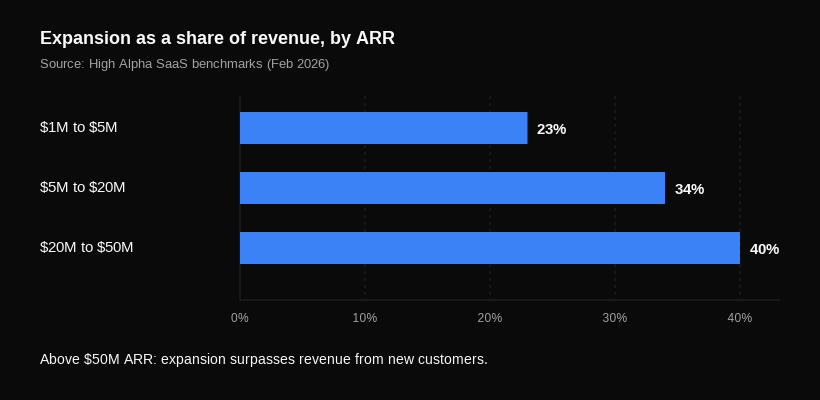 *High Alpha's benchmark figures, linked above. The larger the company, the more of its growth comes from customers it already has.*
All of this is sound. What every guide shares is the unit of the sale: a bigger plan, another seat, a module, a feature behind a paywall. The customer buys more software and is still the one who has to use it.
## What we hear on calls
These are patterns from conversations with software companies this autumn, anonymized, in my words rather than theirs.
**The most requested add-on is work, not a feature.** A campground reservation software company we work with prices per reservation, and its customers have essentially one paid add-on, text messaging, which they switch on themselves in their settings. When I described how a vendor could sell AI-run services on top of its own tools, their sales lead said the request they hear most, from current and new customers alike, is reporting. Today each report is pulled by hand. Nobody was asking for a better reports screen. They were asking for the report to arrive. We wrote about the adoption side of the same company in [product adoption as a job](/blog/product-adoption-as-a-job).
**The decision-maker wants to see it working first.** At that same company, the person who signs off on new spending had already told us they wanted to see the agent working before any additional pricing was discussed. I agreed, and told his team there was no rush on payment until they had seen the value. I think that instinct is right, and it is the opposite of an upsell play: the proof comes before the offer, not after.
**The signal for expansion often arrives as an ordinary message.** On a call with a learning platform company we work with, I described a customer emailing their account manager to ask about an upgrade, or about something custom, and the AI working out in the background what that account has, what it uses and what would help, then handing the account manager a plan. Their founder said that happens to them. Their support team also told us they watch by hand for a drop in tickets from an account, because silence often means a customer has stopped using the product. The same reading of an account that catches risk is what finds the next job.
**Buyers start with the first job and treat add-ons as later.** When I showed a rewards platform in November how a vendor can sell its own AI services to its customers, through its own Stripe account, the team was most interested in the first job, handling their own customers' requests. I described the add-on side honestly as forward thinking, and we are proving it out with one customer. That is the order we see everywhere: the first job earns the trust, and the second job is the expansion.
## Expansion as the next job
A [service](/services), the way we define it, is a job the AI owns for each customer and keeps working with the vendor's tools: get every new location set up, keep every account's data clean, make sure every customer gets their weekly numbers. It holds a state you can check, and it acts when that state slips.
If that is what customers buy first, expansion looks different:
- **The opportunity is found by the job, not a calendar.** The AI doing the current job for an account sees what that account does by hand next to it. To take an illustrative example, a customer who exports the same data every Monday to build the same summary is asking, without saying so, for a reporting job.
- **The pitch is evidence, not a script.** When a customer asks about an upgrade, the AI can look at the account, what they use, and what the next job would change, and hand the account manager a short plan to share. The person still has the conversation. They just start it knowing the account.
- **The price is for a job, not a tier.** What the vendor sells is "your weekly operating report, done for you," or "every new site set up," usually as a subscription for the job. That is easier to justify than a plan upgrade, because the customer already knows what the job does.
- **Proof comes first.** A job can run for a pilot account before anyone pays, and the team can show it working. That is what the decision-maker in our reservation example asked for.
The usual levers do not disappear. Tiered pricing, seat growth and usage-based plans still work, and High Alpha's numbers suggest they will keep mattering as a company scales. Jobs add a second lever that does not depend on the customer using more of the product themselves.
## How we set ours up
We run our own customer success and account management as services for Aimdoc's customers, so this is how we think about it from the inside.
**The commercial job is separate from the delivery job.** In our setup, a customer success service handles the work and the reporting, and an account management service handles the commercial side. The job that does the work notices the gap. The commercial conversation is still led by a person, with the evidence the job gathered.
**Selling a job runs through the vendor's own billing.** On Aimdoc a vendor gives each [service it sells](/services/sell) one access setting: included with a plan, requestable, granted by hand, or sold through Stripe checkout, as a subscription or a fixed term. The vendor is the merchant of record, and receipts, refunds and payouts stay in the vendor's own Stripe account. A pilot customer can be granted a service by hand without being charged, which is how proof comes before price.
**Keep two kinds of money apart.** What the vendor charges its customer for a job is the vendor's own price. The credits the vendor prepays Aimdoc cover the AI's work on that job. Set the price comfortably above what the job costs to run, and the difference is the vendor's margin.
**Read the account the way the job reads it.** The same per-account reading that tells you an account is healthy or slipping tells you what it needs next. We wrote about using that state as the thing a job works on in [customer health score as a job](/blog/customer-health-score-as-a-job).
## Why the vendor should sell the next job
None of this is a new idea about services. Foundation Capital's thesis on [service as software](https://foundationcapital.com/ai-service-as-software/) describes the shift as a "$4.6 trillion opportunity" and notes that when a company sells access to a tool, "customers are still responsible for using that tool." Expansion inside SaaS has always followed that pattern: the customer bought more tool and did more of the work.
What is new is that the vendor can now sell the work itself, to accounts it already knows, through a job that is already running there. The vendor owns the product, the data and the customer. That makes it the natural seller of the next job, and the existing account the cheapest place to sell it.
## FAQ
### What is expansion revenue?
Expansion revenue is additional recurring revenue from existing customers, mainly from upsells, cross-sells and add-ons. It excludes new customers and plain renewals at the same price.
### What is a good expansion revenue rate?
ChurnZero puts a good expansion revenue rate at 10 to 30%. High Alpha's benchmarks show expansion's share of revenue rising with size, from 23% at $1M to $5M ARR to 40% at $20M to $50M.
### How do you increase expansion revenue in SaaS?
The standard levers are tiered or usage-based pricing, prompts at usage limits, cross-sells and add-ons, and timely conversations from customer success. Our addition is to sell jobs: find the work each account does by hand, show the job running for a pilot account, then price it as a subscription for the job.
### Who should own expansion revenue?
Most guides give it to customer success, with sales for larger deals. We would keep the conversation with a person and give the noticing to the job that is already working in the account, so the person starts with evidence.
---
Aimdoc runs jobs like these for each of your customers, through your product and your systems, and lets you sell them through your own Stripe account. See how [selling services](/services/sell) works, [start free](https://app.aimdoc.ai/signup), or book a demo.