AI agents for customer success teams come in two kinds. The first kind works for the CSM: it summarizes calls, scores health, drafts the check-in, and flags churn risk. The second kind works for the customer: it owns a job for every account, like getting each new account to first value, and does that work inside your product. The first kind makes the team faster. The second changes what the team is for, because the CSM's book stops being every account and becomes the exceptions the job raises.
Almost everything written about AI for customer success covers the first kind. That is reasonable. It is what the CS platforms sell, and it saves real hours.
But the conversations we have had with software companies this year point somewhere else. The CS and support leaders we talk to are not asking for faster CSMs. They are asking how every account gets its work done when nobody on the team will ever reach most of them. One founder told us they plan to hire new people to work alongside agents, not to process tickets. Another team told us, firmly, that they want the AI to teach their users, not quietly configure things for them. Those two remarks describe a different CS team than the one the ranking articles describe, and this post is about that team.
What the current advice says
Read the pages that rank for this topic and you get a consistent picture. MindStudio's 10 AI agents for customer success teams lists onboarding automation, health monitoring, churn prediction, ticket triage, renewal management, and meeting prep. tl;dv's guide to AI agents for customer success covers ticket routing, automated reporting, health scoring, and CRM updates. ChurnZero's piece on making AI agents work for your customer success team is the most thoughtful of the group: it argues for building trust gradually, with full autonomy on some actions and approval on others, and for matching the AI strategy to the outcome the team owns.
All three land in the same place. ChurnZero's CEO puts it plainly: "With AI handling the routine things, it's up to the humans to do the work we hired them for to begin with."
We agree with that, as far as it goes. The problem is the shape of the book it leaves in place.
The book was never coverable
Here is the arithmetic every CS leader already knows. SuccessCOACHING's benchmark puts the median SMB book at 110 accounts per CSM, against 35 in mid-market and 10.5 in enterprise.
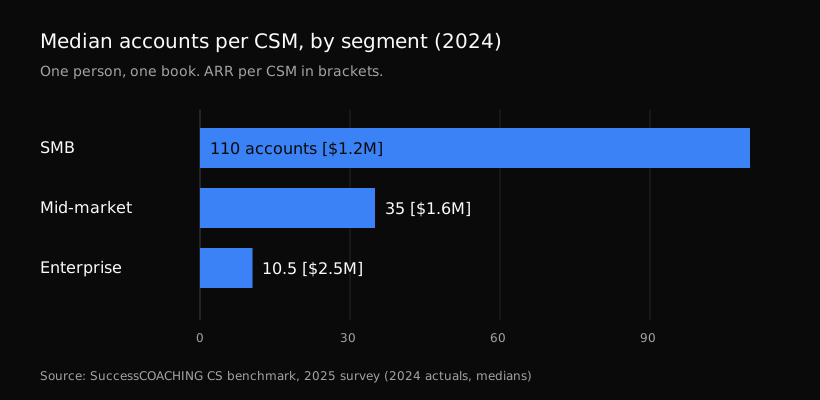
Median accounts per CSM by segment, 2024 actuals from SuccessCOACHING's 2025 survey.
Make that SMB CSM twice as efficient with call summaries and drafted emails and they still cannot do the work in 110 accounts. They can watch 110 accounts more closely. Watching is what CS tooling was built for, because until recently the only thing that could act on a struggling account was a person.
The industry's answer so far has been to stop pretending. Gainsight describes pooled customer success, where groups of CSMs share accounts instead of owning a book. One company in that piece keeps a dedicated CSM for the most complex 30% of its base and puts the remaining 70% in the pool. Gainsight's 2026 priorities post, drawing on its 2025 Customer Success Index, describes the shift toward digital-first and pooled delivery and quotes a CCO saying "You're seeing more decrease than increase in overall headcount."
Pooling and digital programs are honest about coverage. They are still a person or an email sequence pointed at an account. The work in the account, the setup, the integration, the configuration that decides whether a customer gets value, is still the customer's to do.
What we have seen on calls
This is the part the ranking pages cannot cover, so here it is plainly, anonymized.
The best CS motions do not scale, and their owners know it. One software company we work with built its reputation on onboarding every customer by hand: a person on the phone, setting up the account, the integrations, the rules. Customers loved it. It was their edge. It was also the thing they could not keep doing as the customer count grew. What they described wanting was not a better playbook for their team. It was the AI doing that setup for each customer, the same way their best person did.
The bottleneck is usually first-line work across accounts that all differ. A learning platform founder we spoke to this week described the hardest part of their support and success load as first-line work in heavily customized accounts. Every account is set up differently, so every question needs that account's context. Their plan for new hires is telling: people who work alongside agents, not people who work the queue by hand. That is a hiring plan built around exceptions, not around volume.
Teams want the customer to learn, not just to be served. A hospitality software team watched a demo of an agent completing onboarding steps and pushed back on one thing. Their users have to understand the product. They wanted the agent to show people where things live and explain why, and only change settings when that is the right call. We think they are right, and it is a design choice a CS team should own, not a model default.
What changes when the AI owns a job
Put those together and you get a different model of AI agents for customer success teams. The AI does not assist the CSM on 110 accounts. It owns one job across all of them.
A job is not a task or a report. It is an ongoing piece of work with a state you can check. "Get every new account to first value" is a job: for each account, the AI knows how far setup has got, does the next step with that customer's permissions, nudges or asks when it needs the customer, and keeps going until the state says done. (We wrote about what that looks like for the customer; this post is about the team.)
When the job runs on every account, the CSM's book changes shape:
| Before | After |
|---|---|
| Every account in the book, ranked by a health score | The accounts the job could not finish |
| Chasing setup that stalled | Deciding why setup stalled when the AI could not fix it |
| Writing the follow-up | Reviewing what the job did and steering it |
| Same playbook for 110 accounts | Judgment where the account needs a person |
The work that stays human gets sharper, not smaller in value:
- Judgment calls. A customer asks for something that is technically possible and probably a bad idea. The AI should ask, and a person should decide.
- Relationships that need a person. The executive sponsor, the renewal that is really a renegotiation, the customer who is upset. Keep your CS platform and your health scores for this. They make these conversations better.
- Defining the job. What does "first value" mean for your product? Which steps should the AI do, and which should it walk the user through so they learn? That is a CS decision, informed by everything your team knows about how customers succeed.
- Teaching the AI. When the job hits something it cannot handle, the answer a person gives should apply to the next account too. That is where a CS team's knowledge compounds instead of living in one person's head.
What the team stops doing
Be specific about this, because it is where the time comes from.
The team stops chasing stalled setup account by account. It stops writing the same "I noticed you haven't connected X yet" email to every account in the bottom of the health ranking. It stops being the only path from "the customer wants this done" to "it is done".
What it does not stop doing is caring about every account. The difference is that caring no longer requires a person's hours on each one. If you have read our take on AI onboarding for SaaS, this is the same argument from the other side of the table.
Where to start with a small team
If you run a three-person CS team with a few hundred accounts, here is what we would tell you over coffee.
- Pick one job, not ten agents. The ranking pages list ten use cases. Choose the single piece of work that most decides retention for your product. For most products it is setup to first value.
- Write down what done means. If you cannot state the job's finished state per account, the AI cannot hold it either.
- Decide what the AI does and what it teaches. Make the call per step. Some steps the customer should never have to do. Some they need to learn.
- Route exceptions to a named person. Through the channels your team already uses, like Slack or email, with the account context attached.
- Do not automate the relationship. Executive check-ins, renewals with real negotiation, and unhappy customers stay with people.
Do not start by automating the CSM's emails. It saves time and changes nothing for the accounts nobody reaches.
Where Aimdoc fits
This is what we build. Aimdoc connects to your product through its MCP server or API, and to your systems like your CRM, Slack and email, and then owns jobs for each of your customers. A service is a job, not a task: it has a state to hold, the tools it may use, and the limits it works within, and it loops your team in when a person should decide. The CS team defines the job and works the exceptions. The AI does the work in every account.
If your CS team spends its week on accounts it can never fully reach, start with one job. See how services work, or start free and connect your own product.