A customer health score is a single number, grade or color that combines signals like product usage, support activity, sentiment and business outcomes to show how likely an account is to renew, expand or churn. Every guide that ranks for it explains how to pick the inputs, weight them and sort accounts into green, yellow and red. Then the score goes on a dashboard, and a customer success manager decides what to do about the red ones.
That last step is where the score breaks down for a vendor with hundreds of smaller customers. Nobody has time to act on every yellow account. Our view, from our calls with post-sales teams and from running a customer success job for our own customers, is that the score is more useful as the state a job holds: "keep every account healthy" becomes a job the vendor's AI owns for each customer, the score's inputs become the things it checks and fixes on every pass, and a person is pulled in only for what the job cannot fix.
Two things follow that the templates miss. Most of the weight in a typical health score sits on inputs the vendor's AI can act on directly, like unfinished setup and unused features. And the inputs only mean something when they are read against how that particular account is set up, which is exactly the context a weighted formula throws away.
What the health score guides agree on
The guides are consistent, and most of what they say is right.
Planhat's guide defines the score as a composite of usage, sentiment, support behavior and business outcomes. Its example weighting puts product adoption at 40%, business outcomes at 25%, sentiment at 20% and support at 15%, with red at 0 to 59, yellow at 60 to 79 and green at 80 to 100. It recommends defining health separately for each segment, starting the weights from churned and renewed accounts rather than opinions, and checking churned accounts against their score 90 days earlier.
ChurnZero's definition suggests five to seven factors, each worth 10 to 20 points on a 100-point scale, with separate scores by lifecycle stage and by customer fit. HubSpot's guide walks through the same five steps: define a healthy customer, pick predictive metrics, weight them, segment into healthy, monitor and at risk, and refine over time.
On what to do with a falling score, the advice is also consistent: trigger proactive outreach, run an enablement play, assign someone to reconnect. Planhat suggests a time-bound recovery plan with extra check-ins for red accounts.
Every one of those actions is a person's time. That is fine when a CSM looks after a few dozen accounts. It is not fine at the ratios most vendors actually run. Jason Lemkin's rule of thumb at SaaStr is $1M to $2M of ARR per CSM, which at a $20,000 contract means 50 to 100 accounts each, and more in smaller segments. Gainsight's 2025 Customer Success Index, drawn from more than 400 companies, reports that teams on its platform carry roughly 25% more accounts per CSM in commercial and enterprise and nearly 70% more in SMB than teams that are not. The direction is clear: each person covers more accounts, so each yellow account gets less of a person.
What we hear on calls
The health score rarely comes up by name on our calls. What comes up is the work behind it, and three patterns repeat.
The signals teams trust are not in the template. The support team at a learning platform company told us they watch for a drop in tickets from an account, by hand, because when a customer stops asking questions it usually means they stopped using the product. A score that treats rising ticket volume as a warning sign, as HubSpot's guide does, would read that same quiet account as fine. Giva makes the same point in its guide to health scores from help desk data: an account whose ticket volume drops toward zero is not necessarily a success story, and a sudden quiet queue should prompt a check-in, not count as a win. The team that told us this knew it from experience. Their score did not.
The right reading depends on how that account is set up. The same company runs most customers on its core product and some on customized variations. They want the AI to check which one an account is on before it decides anything, and to hand it to a person when it is not sure. A head of post-sales at an accounting software company told us the same thing from the support side: a generic answer is often wrong, because the right one depends on how that customer's environment was configured. A single weighted formula cannot see any of this. An agent working in that customer's account can.
Teams want the fix, not the flag. The learning platform team described the moment they would most like to catch: a customer tried to change a setting, did not finish, and gave up. They would rather the AI noticed and offered to help than have it show up later as a lower adoption number. That is not a score problem. It is a job that was not finished.
The score as the state a job holds
A service, the way we define it, is a job the AI owns for each customer and keeps working, not a one-off task. It holds a state you can check, and it acts whenever that state slips. "Keep every account healthy" fits that shape well, and the health score is the natural state for it to hold.
Here is how the inputs change when a job holds them instead of a dashboard:
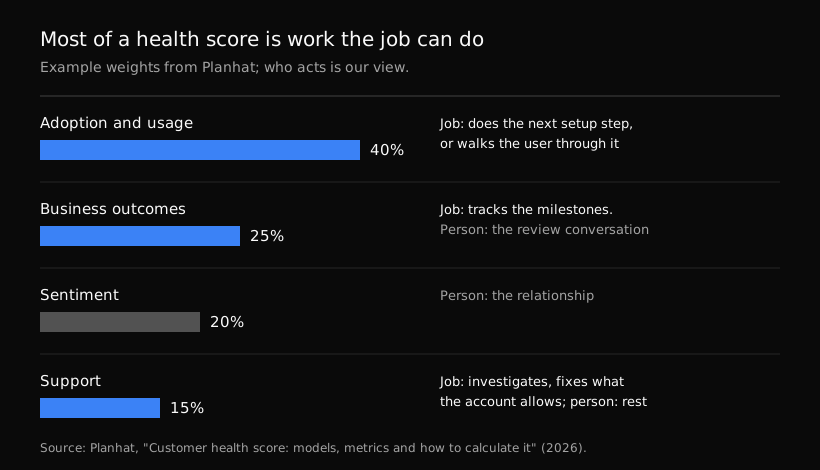
Planhat's example weights, with our view of who can act on each input.
- Adoption and usage. This is the biggest component in Planhat's example, and the one the AI can do the most about. Setup left half done, an integration that broke, a core feature never turned on: the job sees it in the account, does the next step with that customer's permissions, or walks the user through it if the vendor wants customers to learn where things live. We wrote about what that looks like from the customer's side in AI for customer success.
- Business outcomes. The job tracks the milestones that make up "this customer is getting value" and moves the ones it can. The review conversation stays with a person.
- Support. The job investigates issues in the account, fixes what the account allows, and passes the rest to the team with the evidence already gathered. It also notices when an account goes quiet, and treats that as a reason to look, not a reason to relax.
- Sentiment. This one stays with a person. An upset customer, a sponsor who left, a renewal that is really a renegotiation: the job can surface these, but should not try to resolve them.
On those example weights, three of the four components, 80 points of 100, describe work the job can do or move forward itself. That is the core of our argument: a health score built this way is mostly a to-do list the AI can work, not a forecast someone has to read.
How we run ours
We run a customer success job for our own customers on Aimdoc. It wakes on a schedule and on product events, checks the account, and acts. The questions we want it asking on every pass are the ones a good CSM would ask: has this account gone quiet, is setup stuck, did they ask for something we have not delivered yet.
When it hits a judgment call, it goes to the person assigned to that account, in the control plane or in Slack, as described on our services page. When a customer asks for something the product does not do yet, the job opens the ticket, follows it through to release, and tells the customer when it shipped. The account's state moves because the work got done, not because someone read a number and sent an email.
What we would tell a CS leader who asked what to measure once an AI is doing the work: keep the score, but split every input into three groups. The ones the job can fix, the ones it needs the customer for, and the ones that need a person. Then measure the job on how quickly it moves the first two, and measure your team on the third.
What does not change
This does not replace your CS platform or your team. Planhat's advice to start the weights from real churned and renewed accounts still holds, and so does segmenting by lifecycle stage. The relationship work, the executive sponsor, the hard renewal, still needs a person, and the job should make those conversations better by doing the groundwork before them.
What changes is the default. Today a yellow account waits until someone has time. With a job holding the score, the account gets worked the day it slips, and your team's book shrinks to the accounts the job could not finish.
FAQ
What is a customer health score?
A single number, grade or color that combines product usage, support activity, sentiment and business outcomes to estimate how likely a customer is to renew, expand or churn. There is no standard formula; each vendor weights its own inputs.
What metrics should a customer health score include?
The common set is adoption and usage, business outcomes, sentiment (NPS, CSAT) and support activity. Add the signals your own team already trusts, even if templates leave them out. A drop in tickets from a previously active account is a common one.
Does an AI agent replace the health score?
No. The score becomes the state the agent's job keeps checking for each account. It still tells your team where things stand; the difference is that most of the inputs get worked on as soon as they slip.
If your customers need work done to stay healthy, give that work to a job instead of a dashboard. See how services work and how to sell them as your own, or start free.